Wednesday, April 3, 2024

Counseling at the workplace: Role of counselling psychologists in workplace


Meaning-cum-Definition

            It is referred to as occupational counselling, employee counselling or workplace counselling. Workplace counselling refers to the ability to deal with issues that occur within an organization, such as conflict, stress-related absence, work-related trauma, and harassment/bullying” (Hughes & Kinder, 2007).

             Workplace counselling refers to, “Counselling provided in the work setting (whether this is internal or external service provision), to help employees with any mental health issues that have arisen from or are worsened by work” (Bajorek& Bevan, 2020).

Introduction

            According to Bull (1992), the history of workplace counselling shows that it has passed through four stages:

1.         The ‘disease stage’, where individuals are seen as victims of an illness which they must learn to manage, e.g., alcoholism.

2.         The ‘client-centred stage’ (a move to a broad-brush approach), where the post-war development of humanistic/existential therapies, in conjunction with more traditional approaches, enabled employee assistance to help individuals identify and meet their own needs.

3.         The ‘employee-work stage’, where the workplace is acknowledged as influencing individual well-being.

4.         The ‘company as client stage’, where the organization's policies and philosophy influence the individual, community and the planet. An extensive review of literature by Bull (1993) showed, however, that most of the counselling occurs at the individual level.

Purposes of workplace counselling

Ø  To provide a safe and healthy work environment.

Ø  To provide support to employees to deal with major changes in work and non-work-related areas of life.

Ø  To reduce stress among employees.

Ø  To work for the welfare of the employees which enables the organization to attract as well as retain their valuable and efficient employees.

Models of Workplace Counselling

Hughes and Kinder (2007) have suggested the following models:

1.         In-house service or Internal Provision (organization employs a counsellor or hires a counsellor on a contract).

2.         External Provision (Employee Assistance Program, EAP)- It consists of face-to-face counselling, telephonic, and web-based counselling.

3.         Hybrid (internal and external services) – It is a mix of external and internal services, e.g., face-to-face (internal) counselling along with telephonic (external) counselling. A hybrid model helps to maintain the balance between internal and external counselling services enabling the organization to avail the best of each service.

4.         Outsourced – It is more often employed by small organizations for workplace counselling whenever the need for it arises. Though it is not available around the clock, however, it is helpful and cost-efficient.


Carroll (1996) provided the following workplace counselling models:

1.         Counselling-orientation models - The main aim is to focus on the needs of an employee as a client and to bring a positive change.

2.         Brief-therapy models - In workplace counselling it is used where financial consideration is more important than the needs of the client.

3.         Problem-focused models - It is a time-bound approach where the focus is on the immediate presenting problem of the employee. It can provide help within a short span of time.

4.         Work-orientated models - Focuses only on the factors that are blocking the work of an employee at his/her workplace and excludes all the other underlying problems that are not work-related.

5.         Manager-based models - Some organizations may allocate counselling roles to their managers. However, these two roles should be kept separate due to issues like confidentiality and professional expertise.

6.         Welfare-based models - Welfare officers can also serve as counsellors, however, the effectiveness of such counselling depends on the skill of those welfare officers.

7.         Organizational-change models - Counselling is specifically focused on organizational growth, development, and transition, with an aim to be integrated with the organization.

Salient Features

1.         It is a situation-specific and a time-limited endeavour that is focused on the resolution of a current problem.

2.         It is a service arranged by organizations to support and manage the mental and emotional well-being of their employees.

Role of counselling psychologists in the Workplace

            Workplace counsellors must have knowledge of the organization, its culture, and the factors that may affect the well-being of its employees. Also, workplace counsellors should neither give advice and action plans to employees nor should they be judgmental or exploit the employees for their weaknesses, thereby harming the employees’ careers.

How does Workplace Counselling Defers from Other Types of Counselling?

It is provided in the workplace setting.

It focuses only on workplace issues or workplace-related issues that might adversely affect the employees’ productivity.

Workplace counsellors must understand the organizational processes, culture, practices, and challenges that can influence the well-being of an organization and its employees.

Role of Counselling psychologists in the Workplace

1.         Satisfaction of client and organisation.

2.         Maintaining confidentiality

3.         Developing positive attitude of employees

4.         Educating colleagues about the purpose and value of counselling

5.         Avoiding being overwhelmed by the number of clients, or becoming the conscience of the organization

6.         Avoiding the threat to reputation caused by 'failure' cases

7.         Creating a healthy dialogue between the organization and employees to narrow the gap between the organization and employees.

8.         Prevention rather than the treatment of the problem.

Organisations Promoting Work Place Counselling

1.         NGO Arogya World - Initiated an award, namely, ‘Platinum Healthy Workplace Award’. This award is given to the organizations on the basis of their submitted reports regarding the costs of employee health program and the business benefits achieved due to investment in the employee health program

2.         IT company Wipro had initiated an emotional well-being program, named (मित्र). It was a voluntary, peer-led program with a bottom-up approach that was successfully deployed to its large workforce consisting of 175,000 workers to deal with mental health issues.


*********


Monday, April 1, 2024

Test of Significance: t-Test

Introduction 

            The t-test is a statistical method used to determine if there is a significant difference between the means of two groups. Its history dates back to the early 20th century when William Sealy Gosset, an English statistician working for the Guinness brewery in Dublin, Ireland, developed the test. Gosset faced a challenge in his work at Guinness because the brewery's small sample sizes made it difficult to use traditional statistical methods. To address this issue, Gosset derived what is now known as the t-distribution and developed the t-test as a way to compare the means of small samples.

            In 1908, Gosset published his work under the pseudonym "Student" in the scientific journal Biometrika. This is why the t-test is sometimes referred to as Student's t-test.

            The t-test has become one of the most widely used statistical tests in scientific research. It has been adapted and expanded upon in various ways, leading to the development of different versions of the test, such as the independent samples t-test, paired samples t-test, and one-sample t-test, each suited to different research scenarios.

Steps to calculate t-test: -

1. Ensure that the data meet the assumptions of the t-test, such as being normally distributed and having similar variances between groups.

2. Date on minimum two groups are required for t-test.

3. State the null hypothesis (H0) and alternative hypothesis (H1)

4. Calculate the means of each group.

5. Calculate the standard deviation for each group.

6. Calculate the standard error of each group: The standard error is the standard deviation divided by the square root of the sample size.

7. Add the standard error of both the groups and calculate the square root.

8. Calculate the t-value: The t-value is calculated as the difference between the means of the two groups divided by the value of standard error arrived at by square root.

9. Determine the degrees of freedom: The degrees of freedom for an independent two-sample t-test is calculated as (df = n1 + n2 - 2 \).

10. Find the critical value: Use a t-distribution table or a statistical software to find the critical t-value based on your chosen significance level (e.g., 0.05 for a 95% confidence level) and degrees of freedom.

11. Compare the calculated t-value with the critical value: If the calculated t-value is greater than the critical value, you reject the null hypothesis and conclude that there is a significant difference between the two groups. Otherwise, you fail to reject the null hypothesis.


*********

Sunday, March 31, 2024

Interviewing Techniques in Laboratory Settings

 Introduction 

Interview for admission in Gurukul was developed in Bharat almost 3000 years ago. When Chanakya (Vishnu Gupt) sought admission to Takshila University, the Kulpati (Vice-chancellor) interviewed the young Vishnu Gupt. In Ayurveda, the traditional system of medicine in India, interviews were conducted to understand the mental and emotional state of the patient. This helped in diagnosing illnesses and prescribing treatments.

The modern interview technique was developed almost 130 years ago in the Western world through the journalism. 

Interviewing Skills

            The interview must be conducted with ease, competency and proficiency. Interviews are of two types, i.e., Generic and Specific. Following Skills: -

  1. Acceptance,
  2. Empathy,
  3. Communication skills (Genuine listening and articulated speaking),
  4. Comprehension,
  5. Rapport building (Relating Skill),
  6. Paraphrasing and remembering,
  7. Keen observational skills,
  8. Engaging and Exploring,
  9. Information gathering (taking notes),
  10. Probing question ability,
  11. Reflecting ability,
  12. Assessing, analysing and decision-making ability and
  13. Negotiation skills.


******


Sociometry Test

 
Origin: The word sociometry (coined by Jacob Levy Moreno, 1951) comes from the Latin “socius,” meaning social and the Latin “metrum,” meaning measure. The words therefore mean that sociometry is a way of measuring the degree of relatedness among people.

Author: Jacob Levy Moreno, 1951.

Definition: The mathematical study of psychological properties of populations, the experimental technique of and the results obtained by application of quantitative methods.

Objective: Measuring the degree of relatedness or affiliation can not only help in evaluating the degree of cohesiveness amongst the members of the group, work teams, class or organisations. It is a measure which helps in evaluating how individuals associate with each other when acting as a group toward a specified end or goal (Creswell in Moreno, 1960, p. 140).

Purpose: Sociometry serves as a powerful tool in lessening the communication gap and reducing conflict by helping the group to analyse, examine and evaluate its own dynamics. It can also be helpful in finding out the relevant areas or group that requires therapy or training. It help in bringing about positive change and required interventions.

Requirements of Sociometry Test

  1. It must be conducted where people know each other.
  2. At least (minimum) a group consisting of 5-6 members are asked to select or choose members of the same group based on a specific criteria.
  3. The choices of respondents must not be shared with group members.
  4. The test taker should be conversant with the working style of the group.
  5. The experimenter must be culturally sensitive and understand the nuances of group culture.
  6. The experimenter must be well versed with group dynamics.
  7. The experimenter must have observation skills.

Important components

  1. Star
  2. Mutuals
  3. Clique/chain
  4. Isolate
  5. Sociogram
  6. Sociometric matrix

Requirements of Sociometry Test

  1. Sociometric Star: The person whose name is selected (liked) by maximum members of the group is known as the sociometric star.
  2. Mutuals: Where two people choose each other.
  3. Chains or Cliques: Where person A chooses person B who chooses person C who chooses person D and so on.
  4. Isolates: the person who has not been chosen (disliked) by anyone within the group.
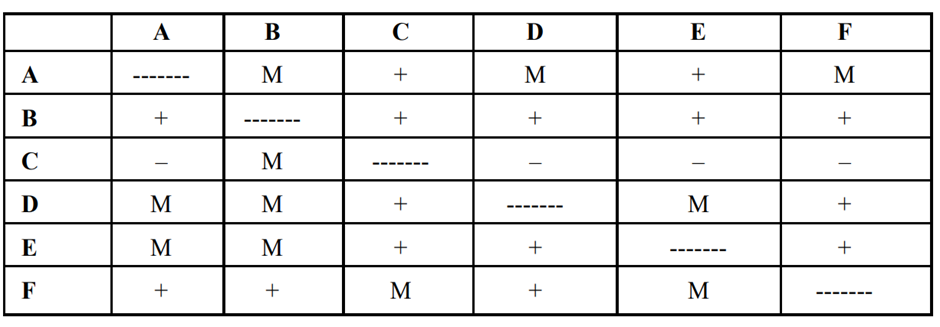
  5. Sociogram: A map, of networks is called a sociogram
  6. Sociometric Matrix: The data for the sociogram may also be displayed as a table or matrix of each person’s choices. Such a table is called a sociomatrix.


*********


Saturday, March 30, 2024

16 PF (Personality Factor) Test

Test Name: 16 PF (personality factors). These are functionally independent psychologically meaningful dimensions. 

Author: Raymond Bernard Cattell in1949.

Definition - The characteristic ways of responding to individuals and situations.

Definition - Personality refers to unique and relatively stable qualities that characterize an individual’s behaviour across different situations over a period of time.

Personality is characterised by the following features:

1. It has both physical and psychological components.

2. Its expression in terms of behaviour is fairly unique in a given individual.

3. Its main features do not easily change with time.

4. It is dynamic in the sense that some of its features may change due to internal or external situational demands. Thus, personality is adaptive to situations

Personality Factors by Raymond Cattell

               He said that humans are innately driven by ergs, which means goals were created because of hunger, curiosity, anger, fear, or other basic motivations which are found in both humans and primates. Ergs example Food Seeking, Mating, Gregariousness, Parental Protectiveness, Exploration, Safety, Self-Assertion, Pugnacity, Narcissistic Sex, and Acquisitiveness.

               Socially created goals are called socially shaped ergs (profession, family and home, spouse, religion) and Cattell gave it the term socially shaped ergic manifolds (SEM). SEM helps in explaining the contribution of the environment to human behaviour.

Formula to predict behaviour (Cattel)

R = f (S ,P )

Where,  R refers to the nature of a person’s specific response,

                              f refers to the unspecified function,

                              S refers to the stimulus situation at a given moment in time and

                              P refers to the Personality structure.

This formula signifies that the nature of a person’ specific response (R), meaning what the person does or thinks or verbalises, is some unspecified function (f) of the stimulus situation (S) at a given moment in time and also of the individual’s personality structure (P).

Personality Factors by Raymond Cattell

Personality is the interaction between the genetic and personality systems and the socio cultural milieu within which the organism is functioning 

ü  There is a common structure on which people differ from each other.

ü  This structure could be determined empirically.

ü  He tried to identify the primary traits from a huge array of descriptive adjectives found in language using factor analysis, to discover the common structures.

ü  Found 16 primary or source traits or factors (16 PF).

Ø  Source traits are stable, and are considered as the building blocks of personality. The source traits are described in terms of opposing tendencies.

Ø  Surface traits that result out of the interaction of source traits.

16 Personality Factors (16 PF)

  1. Abstractedness: Imaginative versus practical
  2. Apprehension: Worried versus confident
  3. Dominance: Forceful versus submissive
  4. Emotional stability: Calm versus high-strung
  5. Liveliness: Spontaneous versus restrained
  6. Openness to change: Flexible versus attached to the familiar
  7. Perfectionism: Controlled versus undisciplined
  8. Privateness: Discreet versus open
  9. Reasoning: Abstract versus concrete
  10. Rule-consciousness: Conforming versus non-conforming
  11. Self-reliance: Self-sufficient versus dependent
  12. Sensitivity: Tender-hearted versus tough-minded
  13. Social boldness: Uninhibited versus shy
  14. Tension: Inpatient versus relaxed
  15. Vigilance: Suspicious versus trusting
  16. Warmth: Outgoing versus reserved

Salient Features

1.    Age: 16 years and above

2.    Test was culmination of 40 years factor analysis on normal and clinical groups.

3.    Forms: 5 (A, B, C, D and E). Forms A, B, C and D are suitable for individuals whose education level is roughly equivalent of normal high school students. And Form E is designed for individuals with marked educational and/or reading deficiency.

4.    No. of items A = 187, B = 187, C = 99, D = 99, E = 128.

5.    Time required A and 45 to 60 minutes, C and D 25 to 30 minutes.

6.    Three alternative answers, forced choice for Form A, B, C and D and for E it is two alternative choices.

7.    For maximum precision minimum two forms should be used on adults. However, due to time constraints one form also can be used.

8.    Most frequently used form is A.

9.    Reading level of Form A and B is 7-8th grade, Form C and D is 6-7th grade and Form E 3-4th grade.

10.    Reliability for Form A and B

                Short interval (immediate to 2 weeks) test retest reliability - .80

               Long interval (2 months to 8 years) test retest reliability - .78

11.    For other forms check manual.

12.    Paper pencil Self administering test.

13.    Scoring: Use scoring key. Add all points and obtain raw score.

14.    Convert raw score into Sten (Standard Ten Mean of Sten score is 5.5 and SD is 2.0) score.

15.    Sten scores 4 to 7 normal while 1, 2, 3 and 8, 9, 10 are extreme and occur less in normal population.

16.    Indian norms on Form A and B were given by SD Kappor in 1991.   

Uses of 16 PF

Ø  Career counseling,

Ø  Marital counseling, and

Ø  For employee testing and selection in business

Ø  Personality assessment

*********